Samba comes from a social movement.
— Nilcemar Nogueira2022
Nilcemar Nogueira

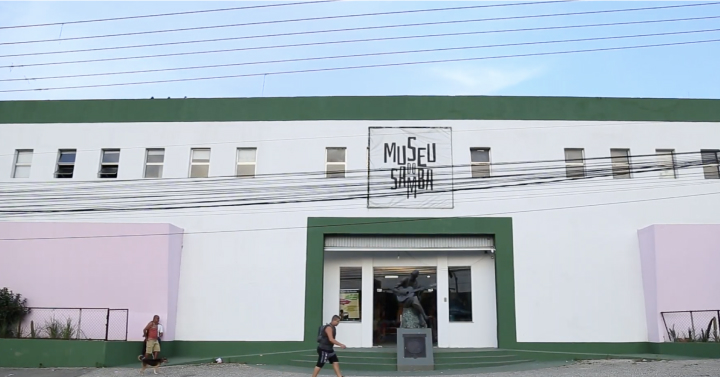
Nilcemar Nogueira grew up in the neighborhoods of Olaria, Realengo, and Praça da Bandeira in Rio de Janeiro, Brazil. Nogueira co-founded the Samba Museum and served as the Secretary of Culture for the city of Rio de Janeiro between 2017 and 2019. In the full interview, Nogueira discusses her family history, her education, the significance of Samba, her work with a Samba school and the Samba Museum, Black womanhood, and her understanding of freedom. This interview was conducted in Portuguese in Rio de Janeiro, Brazil.
Watch the full interviewConversation Transcript
Then it will have an impact in that sense, I mean, me, my family, who comes from this former slave, who then passes… My mother, for example, was a factory worker; my grandmother was a housekeeper. That’s right, almost every story about blacks comes that way… “My… my great-grandfather, my great-great-grandfather was a slave; my grandmother, my mother, was a washerwoman, cook, housekeeper…”. Then the other generation was already a factory worker – which was the case with my mother, a factory worker – and the other generation is already the one that was able to study. Then you can study, then you graduate, then come the impacts of racism that you didn’t expect and that leaves no room to welcome you anywhere else. So, like that, you… Society reserves that place for you: the place of the maid, the nanny, the place of submission and of those manual labor. At the time when you move on to occupy a place and an intellectual workspace: “no, no, that world doesn’t belong to you”. So, as a producer of knowledge – what knowledge, it’s not… And that’s where samba will change my view on all of this. Because, at the same time, samba comes from a social movement, where a social group organizes itself to reoccupy a place from which they were expelled. That the… All the evolution and urban reform of our city will divide classes – poor here, rich there, and it will divide the class. But this group, it, instinctively or not – a part is not instinctively, it is conscious – it will organize itself to occupy. So, you see, back there, for example, in the religious groups that organized themselves to even free others; dockers, working-class organizations. You will have several examples of how these groups are going to be organized, and samba schools are [are] a black class organization movement, on the other hand… because of the cultural bias – an expression that is part of everyday life – and how does it occupy the city.